PHOTOS OF THE SOLAR SYSTEM AND THE UNIVERSE FROM MY BACKYARD
Lyra
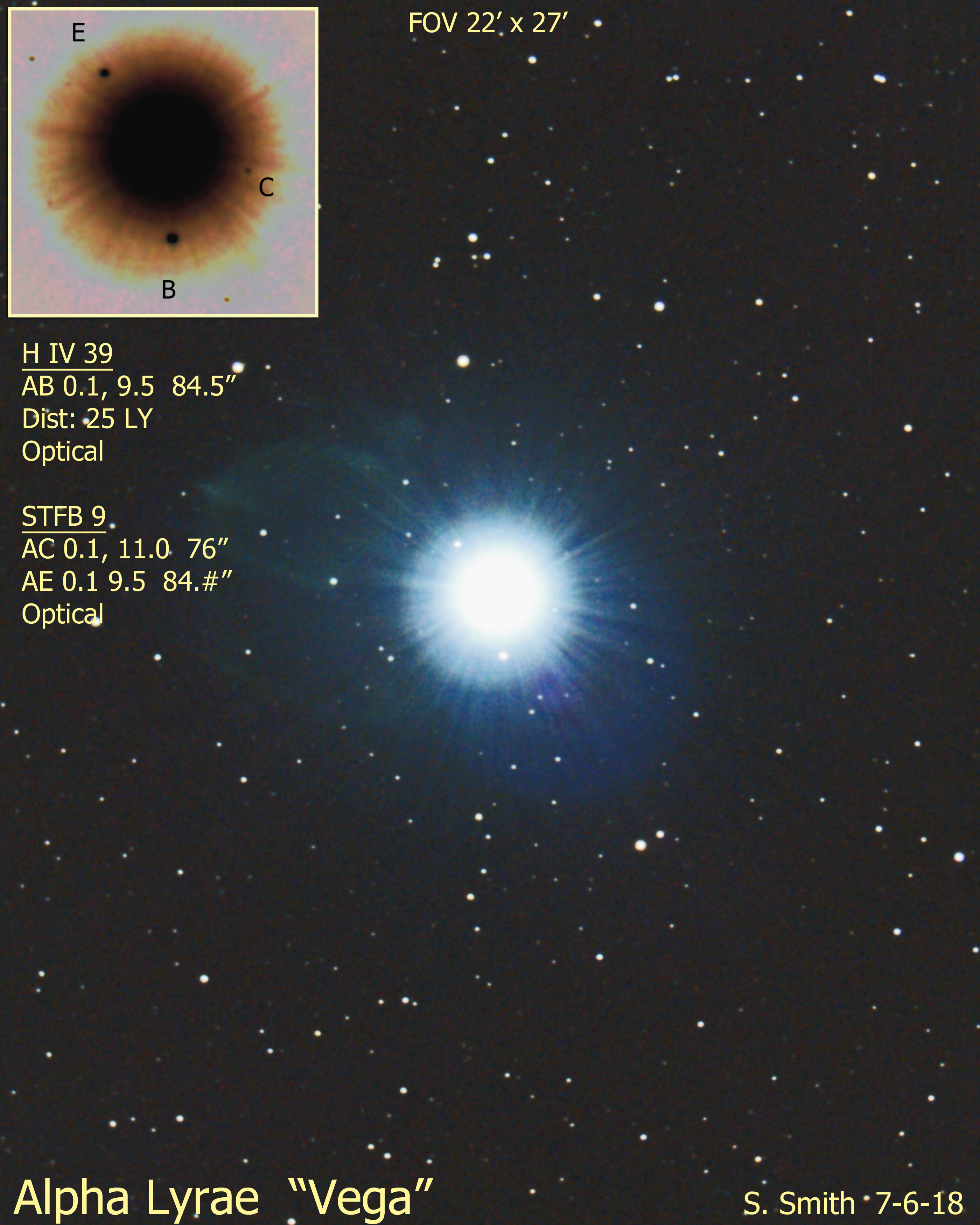
Located 25 Light-years from our Sun, Vega (Alpha Lyrae) is the brightest star in the constellation of Lyra and is the 5th brightest star in the night sky. Though it was catalogued as multiple star in 1781 by John Herschel, it has now been determined that all components are non-physical optical associations.
* * *
The colorful pair of stars, Delta 1 & Delta 2 Lyra form the north-east corner of the Constellation of Lyra. The stars are only an optical association separated from each other by over 400 light-years.
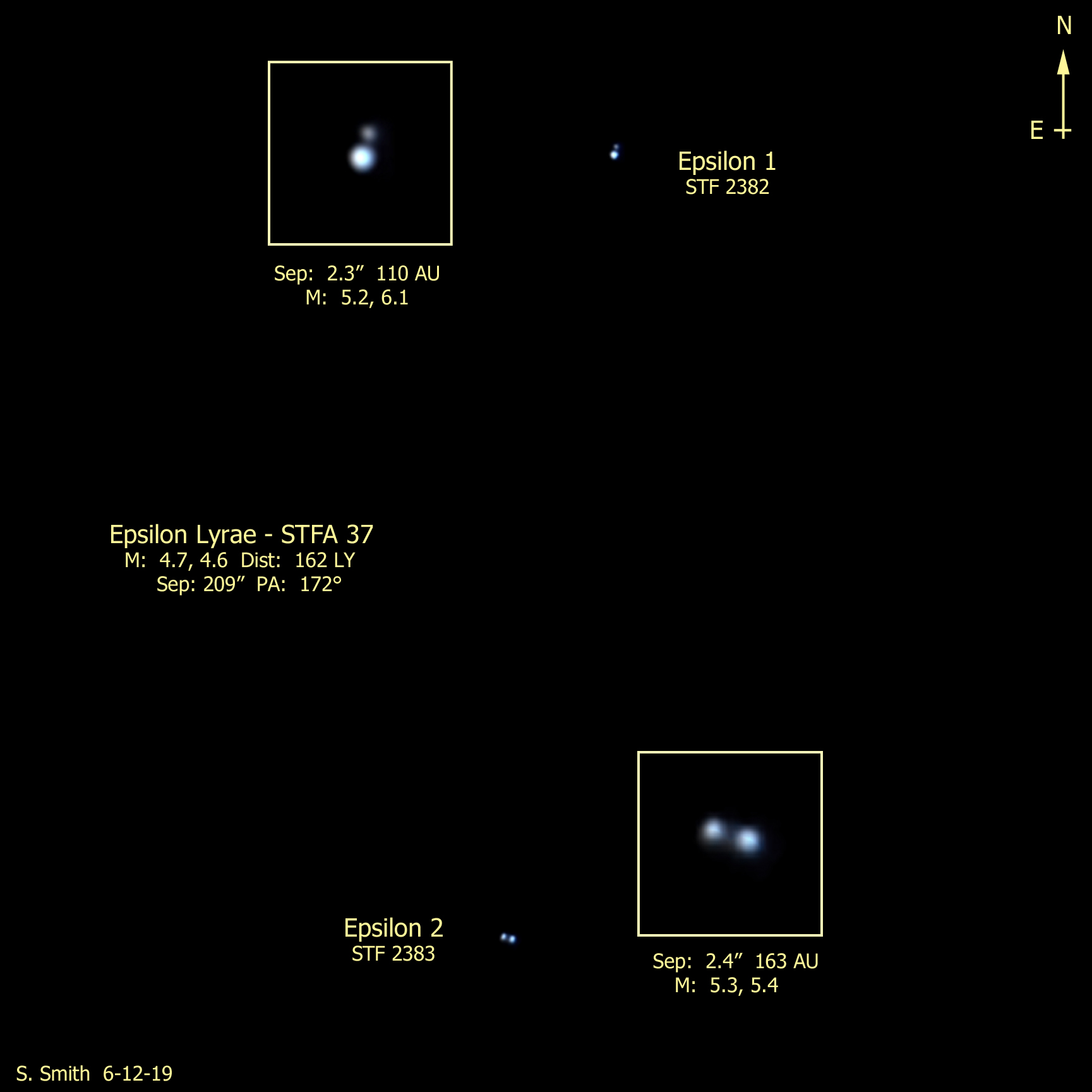
Epsilon Lyra commonly referred to as “The Double-Double” has long been high on every amateur astronomers “Bucket List” of must see objects as well as a test of ones visual acuity and telescope optics. Each of the pairs is physical, and it appears that the pairs are themselves gravitationally bound , making this a quadruple system. * * *
* * *
* * *
* * *
Zeta Lyrae is a physical pair and each component may have a close companion. * * *
* * *
* * *
* * *
* * *
Commonly referred to as “The Other Double Double in Lyra” it is notable that the Position Angle of the two pairs are almost identical. Only the stars of STF 2474 are a true physical system.
* * *
* * *
* * *
Located a short distance north of M57 (The Ring Nebula) is STT 525 a beautiful color contrasting pair. Sharing the view is STF 2421.
A close-up view of STT 525 showing the A-B pair resolved. The striking color contrast of the physical A-C pair is apparent.
KOI 1146 is a very dim physical pair with the primary being a magnitude16 M-class star (designated Kepler 779) along with with a magnitude 20 secondary star separated by 3.9 arc-seconds. In the photo above I have captured the primary but the secondary is beyond the reach of my equipment. What makes this pair interesting is that in 2016 a terre strial sized planet was discovered orbiting the primary (designated as 779b) with a period of 7.1 days. * * *






 Views from Whitby Observatory